
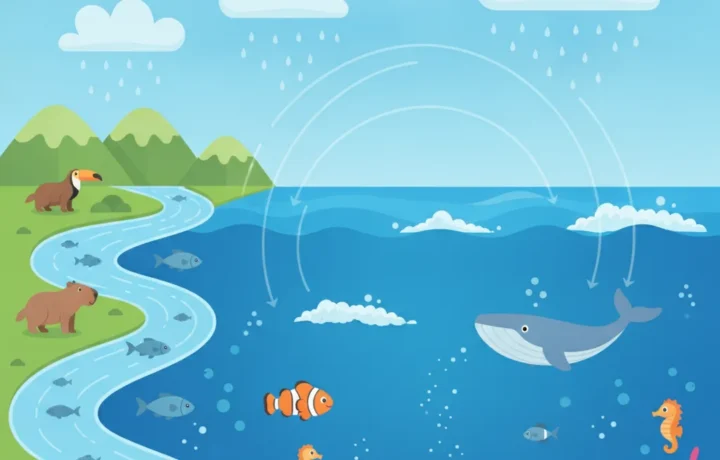
The sea is salty because it receives a large quantity of mineral salts from the continents over millions of years, while rivers remain freshwater because they are constantly renewing their water and always flow away from their place of origin. Thus, the sea accumulates the salt brought by rivers and other natural processes, which explains this striking difference.
Observing the difference between seas and rivers
Anyone who has swum both in the sea and in a river quickly notices a difference: the taste of the water. On beaches, the water tastes distinctly salty. In rivers, that taste is almost imperceptible. The distinction lies not only in taste, but also in how each ecosystem handles minerals.
Beyond taste, the appearance and the feeling of the body in the water prove the difference. It is easier to float in the sea because of the dissolved salt, which increases density. In rivers, the sensation is closer to conventional freshwater, less dense and almost without a noticeable taste.
The phenomenon does not occur by chance. Millions of people notice this contrast every year when travelling. Curiously, even though freshwater carries a little salt from soils and rocks, it never becomes salty like seawater. This raises the question: where does all that salt go?
How salt reaches the oceans
The salt in the seas originates mainly from the minerals present in the rocks of the continents. When rain falls on mountains and soils, it dissolves small amounts of these minerals, which form salts. As the water runs off into rivers, it carries these salts on a long journey to the sea.
On the margins of the continents, rivers gradually release these dissolved minerals, depositing them in estuaries and, finally, in the oceans. The process has been happening continuously for millions of years, ensuring the constant accumulation of salt in the oceans.
- Rain dissolves minerals from rocks.
- Rivers carry dissolved minerals.
- River water flows into the sea.
- Salt remains accumulated in the oceans.
- The cycle continues continuously.
Why salt does not accumulate in rivers
Unlike the oceans, rivers are always renewing themselves. They receive water from rain and underground springs, and continuously flow toward the sea. Because they are in constant motion, dissolved minerals do not accumulate in rivers, being carried onward every time the water follows its course.
If a river, for some reason, had no outlet, over time it could become salty, as happens in lakes without outflow, such as the Dead Sea. However, most rivers drain freely into seas and oceans, which prevents them from becoming salty.
Another important point is the amount of water that passes through rivers daily. This intense flow prevents salt from concentrating, keeping the water fresh for consumption, agriculture and aquatic life.
How salt accumulation happens in the oceans
The sea is very large and has nowhere for its salty water to drain. When seawater evaporates, the salt does not go with it, remaining behind. As a result, over eras, the oceans have accumulated enormous quantities of salt. This process is in constant balance between the inflow and outflow of elements.
Accumulation in the ocean differs from what happens in rivers because of its size and the lack of an outlet to other environments. Thus, even small quantities of salts added year after year eventually form very salty waters.
The saltiest regions of the ocean tend to be those where water evaporates the most, such as enclosed seas in hot climates, because in these places water evaporates more than it is replenished by other rivers, concentrating the salt even further.
Examples of environments with different salinity levels
Not every aquatic environment has the same amount of salt. There are places, such as the Dead Sea, known for a salinity much higher than that of the oceans. This happens because the water has almost no outlet, so it only evaporates, leaving the salt behind.
Some mountain lakes, which receive a lot of rainwater and have a permanent outlet, maintain low salinity. Some estuaries, where the meeting of river and sea occurs, show salinity gradients that vary over time and with the tides.
- Atlantic Ocean: high but stable salinity.
- Dead Sea: extreme salinity due to evaporation.
- Mountain lakes: almost no salt, because of constant flow.
- Estuaries: a mixture of fresh and salt water.
What is still being studied about ocean salinity
Although much is known, there are still open questions about ocean salinity. For example, how climate change may affect the rate of evaporation and the inflow of freshwater. Scientists are also researching how the deep circulation of the oceans may redistribute salt across the planet.
The interaction between deep ocean waters and the seafloor also raises questions about how salt may be recycled or removed in some environments. In addition, the amount of salt over geological eras may have varied, and is still the subject of investigation.
Another topic under research is how long, on average, each salt molecule remains "trapped" in the sea before being removed in some way, whether through mineral formation or other natural processes that take a little salt out of the cycle.
The salt cycle and natural balance
The cycle that keeps the sea salty is a combination of geological and climatic processes that act slowly over millions of years. It is curious to note how freshwater rivers carry minerals without becoming salty, because these small quantities only make a difference when they accumulate in the vast oceans.
Thus, the salinity of the seas is the result of natural balances of salt inflow and outflow. The constant movement of waters, both in rivers and oceans, shows how the planet is always undergoing a silent transformation, shaping environments and life itself.
Frequently asked questions
If rivers carry salt, why don't they become salty too?
Rivers don't become salty because they are always in motion, continuously receiving and releasing water. When river water reaches the sea, the salt separates and begins to accumulate there. This process prevents salt from building up in the rivers themselves, keeping them fresh.
Could the sea become even saltier in the future?
The sea tends to keep its salinity stable because there is a balance between the input of salts from rivers and the removal of salt through natural processes. If something significantly changes this balance, such as extreme climate changes, salinity may vary, but this happens very slowly.
Do all oceans have the same amount of salt?
No, the amount of salt can vary between oceans and even in different regions of the same ocean. Factors such as evaporation, the inflow of fresh water and the circulation of ocean currents contribute to regional differences in water salinity.
Why do we float more easily in the sea than in rivers?
The presence of salt in seawater increases its density, making it easier for objects and people to float. In rivers, which have less salt and are closer to fresh water, this density is lower, making natural floating a bit more difficult.
The history of salty seas and their importance
Understanding why the sea is salty while rivers remain fresh helps us understand the balance of the planet's aquatic environments. It shows how small changes over millions of years can create striking differences that affect ecosystems and the survival of species in certain regions.
The accumulation of salt is an essential part of the natural cycle of water and minerals on Earth. By learning about this process, we realize that even everyday observations, like the taste of water and the pleasure of floating in the sea, originate from long-lasting natural phenomena with enormous impact.