Yawning is a natural bodily reaction that almost everyone has experienced, often associated with sleepiness or boredom. But besides causing that feeling of relaxation, yawning also seems to be contagious, making other people yawn too when they witness the gesture. Scientifically, there are still doubts about the exact reason for yawning and its potential for contagion, but some hypotheses help explain why this happens.
What we observe in everyday life about yawning
Yawning is part of everyone's routine, regardless of age. We usually yawn more in situations of tiredness, monotony, or right before going to sleep. A yawn can last a few seconds and is accompanied by a deep breath and stretching of the mouth. Curiously, even when talking about yawning, some people may feel like yawning immediately.
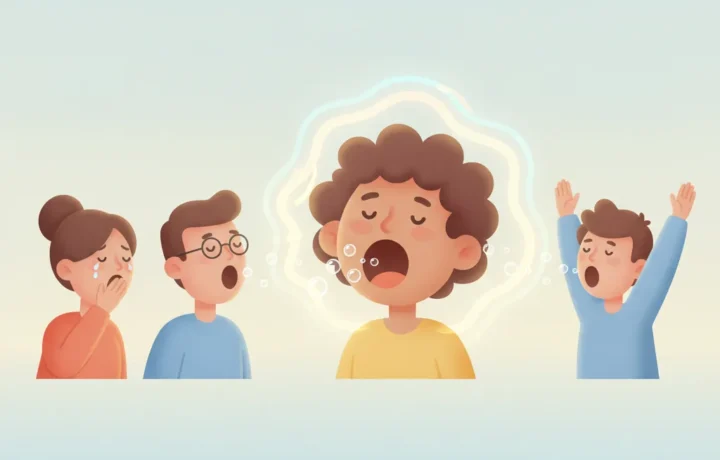
The phenomenon of contagious yawning is observed in many social situations. Just seeing someone yawn, hearing a yawn, or even reading about it is enough for other people to feel like yawning. This instant reaction tends to be even stronger among close people, such as family and friends, than among strangers.
It is not only in humans: many mammals also yawn and, in some cases, yawn in response to the yawn of another animal of the same group. This suggests that yawning and contagion may play an important role in communication and social behavior of some species.
From yawning to contagion: what may be behind it
Yawning is an automatic behavior. When we feel sleepy, bored, or in need of renewed attention, the brain may trigger yawning as a response mechanism. One hypothesis is that yawning helps slightly cool the brain, improving mental performance at certain moments.
Contagious yawning, on the other hand, may be linked to empathy and social connection. Seeing or hearing someone yawn activates brain areas related to understanding what the other person feels, triggering the involuntary urge to yawn as well. This connection is stronger among people who spend a lot of time together.
To explain contagion, it has been suggested that the behavior would be a form of signaling among group members, synchronizing states of alertness or sleep to increase social cohesion and collective safety.
Common questions: examples of yawning situations
Yawning does not only happen when we are sleepy or tired. Yawns appear in situations such as before big presentations, during classes, during long trips, or even in moments of anxiety. It is frequent to see entire groups yawning during meetings, especially when the environment is quiet and not very lively.
In school settings, one student's yawn can trigger a chain reaction, with several others repeating the act right after. In public transport, such as buses and subways, it is common to notice yawn contagion at times close to the beginning or end of the day.
- During long lectures, many people start yawning almost at the same time.
- Mothers and children often yawn together at the end of the day.
- Pets may yawn when they see their owners yawning.
- In groups of friends, all it takes is one yawn for the rest to soon follow.
- Merely mentioning the word "yawn" can provoke a reaction in whoever hears it.
Step by step: how yawning happens in the body
- The brain identifies situations of tiredness, monotony, or need for renewed attention.
- A command is sent to open the mouth wide and inhale deeply.
- The lungs fill with air, causing a small stretch in the facial and neck muscles.
- The body goes through a brief relaxation, sometimes accompanied by tears in the eyes.
- If someone nearby yawns, social brain areas may trigger the reflex yawn.
Yawning does not follow a fixed schedule and can vary depending on the environment, the state of alertness, and even the bond with the people around. Each person may have a different pattern of yawning frequency and intensity throughout the day.
Some people confuse yawning with other facial movements, such as opening the mouth to stretch or breathing deeply, but a yawn is accompanied by a special sensation of momentary relief.
What we still need to know about yawning
There is still no consensus on all the functions of yawning, nor on the exact reason why it is contagious, especially in humans. Scientists continue to study which brain areas are involved in this phenomenon and whether yawning has any direct relation to empathy.
Another question concerns the differences in yawning between species and why some animals show contagion more easily than others. There are hypotheses, but no definitive answer for these variations.
The physiological reasons, such as regulating brain temperature, are also debated. Even with all these assumptions, it is still not fully clear what the main evolutionary function of yawning is, nor why contagion occurs so frequently in social groups.
Frequently asked questions
Can yawning be avoided?
Most of the time, it is not possible to fully control yawning. Even when trying to prevent it, the body may end up yawning involuntarily. Some people manage to delay the gesture for a few seconds, but if the body understands that it is necessary, the reflex happens naturally.
Do children yawn as much as adults?
Yes, children yawn from an early age and, as they grow, yawning may change in frequency according to sleep rhythm, daily stimuli, and tiredness. Even newborn babies already show this gesture, showing that it is a natural behavior from infancy.
Do pets also "catch" yawns from people?
In some cases, yes. There are reports of dogs and other pets yawning after seeing humans do so. The degree of contagion varies according to the species and the animal's closeness to the person, being more common in very sociable animals.
Is yawning a sign of lack of oxygen?
This idea is old, but it is not fully confirmed. It is known that yawning involves taking more air into the lungs, but there is no proof that it serves specifically to meet a need for oxygen. The link between yawning and lack of air is more myth than fact.
Yawning: between mystery and everyday life
Yawning remains one of the most common and mysterious gestures of human routine. It can offer a feeling of relief, indicate sleepiness, or simply happen for no apparent reason. Contagious yawning in groups, in turn, links this gesture to social behavior and empathy.
Despite all the hypotheses, yawning still raises doubts about its exact origin and function. However, whether from sleepiness, boredom, or social context, yawning is a universal behavior that connects people and, in some cases, even different species in everyday life.