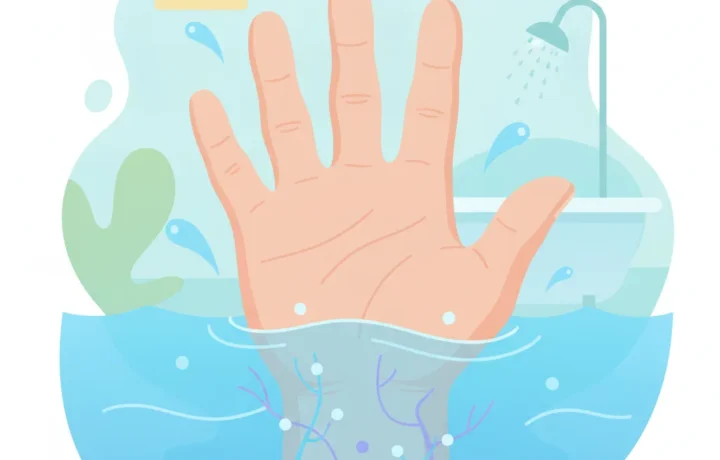
When we spend a long time in contact with water, it is common to see the skin of our fingers and toes become wrinkled. This happens mainly because of a reaction of our nervous system, and not just because the water "swells" the skin. Many experts believe this phenomenon may help improve our ability to hold wet objects.
The beginning of this curious reaction on contact with water
When we dip our hands or feet in water, the outermost layer of the skin, called the epidermis, begins to absorb part of this liquid. Unlike what was once believed, wrinkling does not depend only on direct contact of the skin with water. There is nervous system control that commands this change.
This reaction happens after a few minutes of immersion, and only appears in areas with many nerves, such as the fingers and toes. Areas without this kind of nerve structure, such as the skin of the legs, do not tend to wrinkle in the same way. This difference caught the attention of those who study the subject.
Although it is already a well-known phenomenon in everyday life, most people only notice this reaction after long baths, swimming pools, or even after washing a lot of dishes. The water does not need to be hot; the reaction happens in both cold and warm water.
How the body turns smooth fingers into wrinkled ones
The autonomic nervous system is responsible for automatically controlling small changes in our body. In the case of wrinkling, this system causes blood vessels at the fingertips to constrict. This causes a decrease in local volume and creates the famous creases in the skin.
These furrows appear more on the fingertips because these areas have a greater number of nerve endings. The effect is specific to humans and some other primates. People with injuries to certain hand nerves may not show wrinkling.
Besides the fingers, the area of the feet also shows this effect, although usually more subtly. The length of time in water can influence how intense the wrinkles are, but just a few minutes is enough for the reaction to begin.
Practical examples and situations where you see wrinkled fingers
Many people notice their fingers wrinkling when they spend time playing in the pool or taking a long bath. Children often show their fingers to adults after playing in the bathtub for a while. This effect also appears when washing dishes or clothes for long periods.
- Swimming pools and bathtubs often cause wrinkling of the fingers in children and adults.
- Exposing hands to water while washing dishes can also result in wrinkled fingers.
- During fishing or handling objects in water, wrinkles may also appear.
- In water sports, such as swimming, the phenomenon occurs after a certain amount of time in contact with water.
Even washing your hands many times in a row can cause slight wrinkling, depending on the exposure time. It is not something exclusive to recreational situations; it occurs with any long contact with water.
The possible role of wrinkling in holding wet objects
A much-discussed hypothesis is that wrinkled fingers help increase friction with slippery or wet surfaces. The wrinkled shape works like the grooves of a tire, making it easier to grip slippery objects. There is still no consensus on how much real benefit this brings in everyday life.
Some tests suggest that wrinkled fingers do make it easier to handle objects underwater. This may have been an evolutionary advantage in activities such as gathering food in wet environments. Even so, this idea remains under evaluation in various studies.
Despite the hypotheses, it cannot be said that this is the only function of wrinkles on the fingers in water. The phenomenon still generates discussion, but the link to improved handling is one of the most accepted explanations so far.
What is still unknown about wrinkled fingers in water
Despite progress in research, the complete explanation of why only certain parts of the body wrinkle or why the phenomenon occurs with different intensities is still not settled. There is also uncertainty about how much this actually influenced human behavior in past environments.
Some lines of thought suggest that not everyone shows the same degree of wrinkling. Genetic factors, age, and even health conditions may influence it. Medical literature is still investigating possible relationships between the absence of wrinkling and some neurological diseases.
The molecular details of how the constriction of blood vessels at the fingertips occurs also remain under study. The exact functioning of the signaling between contact with water and the blood vessels involves processes still under investigation.
Frequently asked questions
Can wrinkling of the fingers in water be a sign of a health problem?
In general, the absence of wrinkling when it is expected may indicate a problem with the peripheral nerves, but the isolated effect is not diagnostic. If other symptoms, such as numbness or weakness, are present, it may be important to seek medical evaluation to investigate possible neurological causes.
Why does the skin of other parts of the body not wrinkle as much?
The most pronounced wrinkling occurs where there is a greater number of nerve endings, such as the palms of the hands and the soles of the feet. In these regions, the nervous system's command causes specific blood vessels to constrict, which does not happen in the same way in other places on the body.
Do wrinkled fingers return to normal quickly?
Yes. Normally, after leaving the water and waiting a few minutes, the skin returns to its original state. The exact time may vary, but in most cases the wrinkling disappears within half an hour after the end of contact with water.
Does water temperature change the wrinkling?
Water temperature may influence the speed of the phenomenon, but both warm and cold water can cause finger wrinkling. The effect is more related to the duration of immersion than to the heat or cold of the liquid.
Summary of what we know about wrinkled fingers in water
The wrinkling of fingers in water is a curious phenomenon linked to the functioning of the nervous system. The main hypothesis is that these wrinkles help improve the handling of wet objects, although some points still have no answer.
Despite being something common in everyday life, many details about how and why the process happens are still under study. What is already known shows how this simple effect reveals interesting adaptations of the human body.