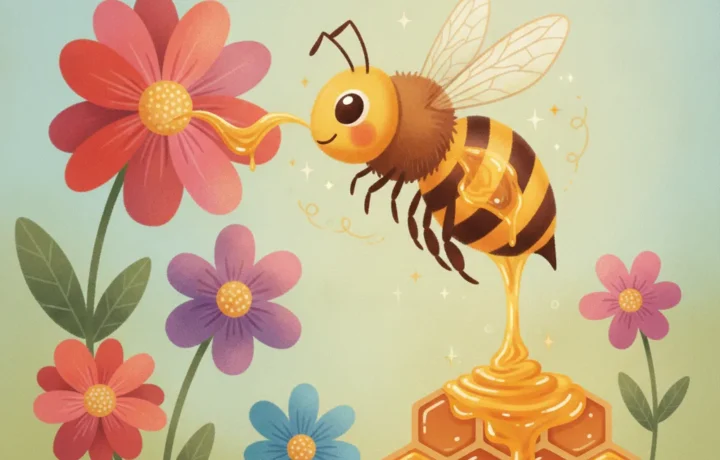
Bees produce honey from the nectar collected from flowers, following a process that involves stages both inside and outside the hive. They use enzymes and collective work to transform this sweet liquid into a dense and nutritious product. The finished honey is stored in the honeycomb cells, where it is protected until it is consumed by the colony. This transformation is an example of the animal engineering found in nature.
Stages of the honey-making process
- The bee collects nectar from flowers using its long tongue and stores it in an organ called the crop.
- During the flight back to the hive, the nectar begins to be mixed with enzymes present in the bee's body.
- In the hive, the bee regurgitates the nectar to other worker bees, which continue the process and add more enzymes.
- The nectar is deposited in the honeycomb cells, where it will be dehydrated by the wind produced by bees beating their wings.
- When the honey reaches the ideal consistency, the bees seal each honeycomb cell with wax, protecting the food.
How enzymes transform the nectar
Inside the bees, enzymes break down the sucrose molecules in the nectar, turning them into simpler sugars such as glucose and fructose. This change is essential for the nectar to acquire the characteristics of honey. The enzymatic process begins during transport and is continued by the bees that receive and handle the liquid inside the hive.
Nectar, naturally very liquid, needs to be modified so that it does not ferment or spoil. Besides the enzymes, heat and movement in the hive help speed up the transformation. The interaction among many bees promotes efficient and continuous mixing, ensuring the quality of the final result.
At the end of this collective work, the original nectar has already become honey, with low water content and high sugar concentration. From this point on, it serves not only as an energy source for the entire colony, but also as one of the most durable food reserves in nature.
Why the amount of honey can vary
Honey production depends on several factors, such as climate, availability of flowers and the health of the colony. In warmer and wetter periods, there are more abundant flowers and plenty of nectar, which increases production. During cold or dry seasons, bees may produce less honey, since fewer natural resources are available.
The type of flower visited also influences the flavor and color of the honey, since each plant offers nectar with different compositions. Thus, the same group of bees may gather nectar from varied sources, which makes the honeys of a single hive quite diverse. Even the location of the hive affects the final result.
In addition, internal factors, such as the size of the colony and the presence of diseases, affect the efficiency of the bees in the stages of collection, transformation and storage. That is why each hive may yield differently from year to year.
Things many people imagine about bees and honey
Many people think that honey appears ready in nature, but it is actually the result of a very elaborate process. There are also those who believe every bee makes honey, but only specific species have this ability. Other common ideas include the belief that honey is derived from pollen, when in fact it comes from the nectar of flowers.
Another frequent confusion is about the time the process takes. Although it may seem quick, honey production can take several days, since it involves many phases of handling and drying. Many people also imagine that the role of bees is limited to collecting nectar, but the activity inside the hive is equally important for the final result.
- Honey must undergo a chemical transformation to be preservable.
- Only a few species carry out the complete honey-making process.
- Pollen serves to feed the larvae and is not the raw material of honey.
- Each stage depends on many bees working in an organized way.
Curiosities about honeycombs and honey storage
Honeycombs do not serve only as storage space. They also protect the honey from humidity, predators and contamination. The wax used to seal the cells is produced by young bees, which secrete small wax plates from under the abdomen for this work.
In addition, the hexagonal structure of the honeycombs is an efficient and resistant solution, allowing maximum storage with minimum use of material. This organization makes it easier to control the temperature inside the hive, which is important for the quality of the final product. When the hive needs extra food, the sealed honey can be opened and consumed quickly.
The honey sealing process demonstrates how bees are able to build incredibly organized and functional environments, protecting the food from microorganisms and other threats until the moment of consumption.
What bees do if something alters the process
If there is a lot of humidity or if the nectar is too liquid, bees increase ventilation inside the hive to speed up the evaporation of water. If nectar is lacking in the region, bees may travel even greater distances to find new sources. These adaptations help ensure the survival of the hive under different environmental conditions.
When threats arise, such as diseases in the flowers or contamination, bees react immediately, reducing collection or even changing their search area. This flexibility is one of the reasons bees are so important for the balance of the environment. Collective work encourages rapid adaptation and distribution of tasks within the hive.
Even in situations of trouble, the instinct of bees is to protect and preserve their reserves. They may, for example, increase wax production to reinforce the sealing of the honeycombs, ensuring that the honey is always safe to consume.
Frequently asked questions
Why doesn't honey spoil easily?
Honey has a low water content and a high concentration of sugar, which makes it difficult for bacteria and fungi to grow. In addition, it contains natural compounds with a mild antimicrobial action. This means that honey, if kept protected and free from contamination, can last a long time without losing its characteristics.
How do bees identify flowers with more nectar?
Bees use sight to detect colors and patterns in flowering fields, as well as a very keen sense of smell, which allows them to perceive the scents of nectar. They can also communicate with each other through movements and dances to indicate the best sources to their colony mates.
What makes honey from different flowers different?
Each type of flower offers nectar with varied chemical compositions, which changes the taste, aroma and even the color of the honey. For this reason, honey produced from a single variety can be very distinct from multifloral honey, resulting in unique flavors and colors in each location.
How do bees keep the hive clean and organized?
They dedicate part of their time to cleaning the cells of the combs and removing waste from inside the hive. Some bees are responsible for removing impurities and even carcasses, helping to prevent diseases. This organization is essential to keep the environment healthy for the whole colony.
The incredible work of bees in honey production
Honey production is the result of many steps and the collective effort of bees. From the field to the sealed comb, everything involves cooperation and natural intelligence. That is why this food fascinates anyone who observes the animal world and seeks to understand its processes.
Beyond its importance to the hive, honey shows how bees play an essential role in nature. Each jar of honey is a testament to a complex cycle, which goes well beyond simply collecting nectar and requires precision in every part of the process.