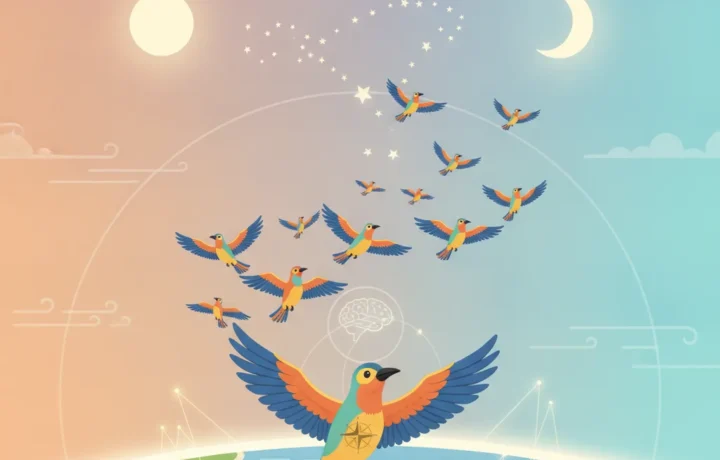
Migratory birds are able to find their way on long journeys by using a combination of different natural cues, including the Sun, the stars, the Earth's magnetic field and landmarks in the landscape. This navigation does not depend on a single sense, but involves several steps and abilities that work together. In this article, you will understand how this process works and which factors influence the birds' route.
Steps in the orientation of migratory birds
- Recognizing the starting point: Birds use known landmarks to situate themselves before starting migration.
- Using the Sun: The Sun serves as a compass during the day, helping to keep the correct direction.
- Orientation by the stars: At night, many birds observe star patterns to adjust their course.
- Sensing the magnetic field: The Earth's magnetic field works as a kind of natural GPS.
- Landscape references: Mountains, rivers and even cities can serve as visual markers along migratory routes.
>
How the Sun and stars guide birds
During the day, birds use the position of the Sun in the sky to orient themselves. They adjust their routes according to the Sun's movement, compensating for the shifting shadows to maintain the right direction. This method requires a kind of "internal clock" that allows the animal to calculate time and correlate it with the Sun's position.
At night, especially under clear skies, birds migrate following star patterns. They recognize constellations and use the North Star as a reference point to fly in the appropriate direction. This is especially common among birds that travel great distances at night.
Young birds quickly learn to use both the Sun and the stars, by observing their parents or through instinct. The precision of these navigations is impressive, even considering variations in weather and light.
Birds' internal compass and the Earth's magnetic field
Many migratory birds have a kind of "internal compass" that detects the Earth's magnetic field. This ability allows them to fly on cloudy days or at night, when the Sun and stars are not visible. This magnetic sensing works as a complement to their other senses.
It is believed that tiny crystals present in birds' heads help them identify the direction of the magnetic field. In this way, even in adverse conditions, they manage to maintain their general orientation.
Besides magnetism, birds adjust their course if they encounter unexpected obstacles along the way. These adjustments are made based on varied environmental and sensory information, ensuring survival during long journeys.
The landscape as a guide during migration
Migratory birds also use elements of the landscape to orient themselves. Large rivers, mountains, coastlines and even cities become visual reference points during flight. This kind of visual navigation is more common in regions familiar to the birds.
These landmarks help maintain the route or serve as resting and feeding points. In unfamiliar areas, birds rely more on solar, stellar or magnetic cues.
Visual navigation is an additional strategy that complements the other forms of orientation, making migration safer and more efficient.
Why some routes vary between species
The migration route can vary according to species, age and even previous experiences. Some birds follow traditional paths, inherited over many generations, while others modify their routes in response to climate or environmental changes.
Different species choose shorter or safer routes, depending on the final destination and flight conditions. Some determining factors include the type of food available and the geographic barriers encountered along the way.
In addition, natural events such as storms or changes in habitats may force birds to improvise new paths during migration.
Common misconceptions about bird migration
A frequent mistake is to think that migratory birds depend on just one sense to orient themselves. In fact, the success of migration results from the combination of several mechanisms. Each sensory cue plays different roles depending on the conditions of the journey.
Another myth is imagining that all routes are fixed and never change. In reality, environmental shifts and behavioral adaptations can alter traditional paths.
Finally, it is believed that birds never get lost, but route errors are possible, especially among young or inexperienced individuals. Even so, most manage to regain the correct course thanks to the variety of natural cues.
Frequently asked questions
How do birds know the right time to migrate?
Migratory birds perceive environmental signals, such as longer or shorter days and temperature changes, to identify the ideal moment to migrate. These signals activate internal processes that prepare the animals for the journey. In addition, group behaviors also help many species depart at the same times of the year.
Do all birds migrate very far?
Not all birds make long journeys. Some migratory species travel short distances between feeding and breeding areas. Others, such as those that cross continents, travel thousands of kilometers. The distance depends on the type of bird, its food needs and environmental conditions.
Can young migratory birds also find their way?
Young migratory birds can fly long distances even without following experienced adults. Many possess a natural instinct that helps them perceive solar, stellar and magnetic field cues. Over time and with experience, they refine the ability to use landscape elements as reference points.
Do human factors interfere with birds' navigation?
Human activities, such as light pollution in cities and the destruction of natural habitats, can disrupt the navigation of migratory birds. Changes in the landscape and unknown obstacles increase the challenges of these journeys. Therefore, respect for natural environments favors the success of migrations.
The fascinating journey of migratory birds
Migratory birds are true navigation specialists, combining cues from the Sun, stars, magnetic field and landscapes to travel great distances. Their adaptability is surprising in the integrated use of several natural senses, making each journey unique.
Although some questions about the process are still not completely resolved, the study of these birds reveals a great deal about the complexity of animal behavior. Every year, millions of birds renew this natural spectacle, crossing skies around the planet with remarkable precision.