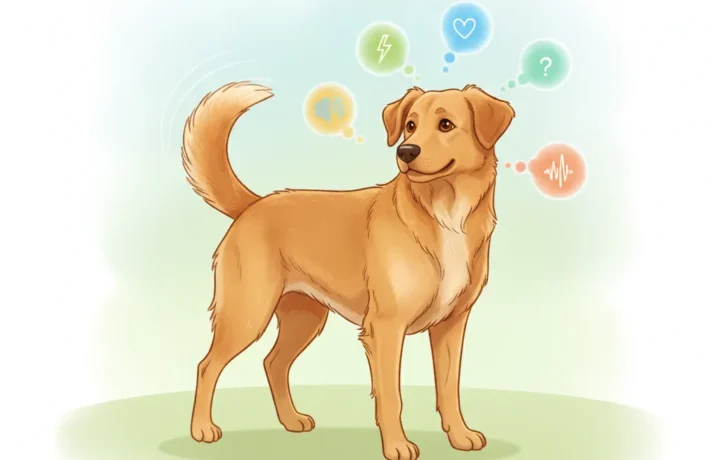
When a dog wags its tail, many people immediately think it is happy. But this gesture is actually a complex form of communication that can indicate various feelings. Dogs use tail movement to convey information to other dogs and to people. Understanding the context and the way the tail is wagged is what reveals the true meaning of this gesture.
The tail as a canine communication tool
A dog's tail works as a body-language tool. Besides sounds and facial expressions, the way a dog moves its tail contributes to communication. It can show excitement, submission, curiosity, or even alertness to possible threats. It is a rich language that goes beyond the idea of happiness.
Dogs communicate mainly with their bodies. The tail, being visible and mobile, plays an important role in this exchange. The position in which it is held — up, down, or horizontal — already gives many clues about the animal's emotional state. An attentive owner can read these signals in everyday life.
Tail movement is also used between dogs to avoid conflict. A gently wagging tail may indicate peaceful intent, while stiff movements may suggest tension. In stressful situations, dogs control these movements much more than one might imagine.
What each tail movement means
The way the tail is wagged, its intensity, and even its direction matter a lot. A wide, loose wag is generally related to a dog's relaxation and contentment. A short, fast, tense wag may indicate nervousness or even irritation. It is necessary to observe the set of signals.
The position of the tail is also fundamental. Dogs with a raised, wagging tail may be alert or excited, depending on the environment. A low tail, although moving, may show submission or uncertainty in a new or unfamiliar situation.
Therefore, it is not enough to look only at the tail. The complete context, including face and body posture, will help you perceive the animal's emotional state more precisely.
Reasons that lead a dog to wag its tail
The most popular cause of wagging is the moment of seeing someone dear or seeing food coming. However, the gesture does not always mean happiness. A dog may wag its tail when feeling fear, uncertainty, or when trying to avoid a confrontation. For each situation, the movement has a different reason.
This behavior also appears during play with other dogs or in interactions with people. They may wag to attract attention, show curiosity about an object, or simply respond to other stimuli in the environment.
- When meeting a familiar person, they wag out of excitement and recognition;
- When meeting another dog, the wag serves as a sign of intent;
- In situations of insecurity, the movement tends to be lower and more restrained;
- When noticing something strange, there may be stiffness and a slow wag, indicating alertness;
- During play, the movement is usually loose and quick;
- When they want to avoid conflict, the tail may keep a gentle motion to convey peace.
Everyday situations in which dogs wag their tails
At the park, it is common to see dogs wagging their tails when they approach other animals. This may be a sign of an invitation to play or just a way to show they are not interested in a fight. At home, the dog may wag upon noticing its owner's arrival or while food is being prepared.
Even during visits to the veterinarian, some dogs wag their tails, but in this case it may be a gesture of submission or uncertainty. Dogs in new environments may also move their tails to communicate that they pose no threat, seeking a cautious approach.
It is interesting to observe that, in situations of fear or stress, the tail may stay between the legs yet still move slightly. In cases like this, the wagging is not related to happiness but to an attempt at communication in the face of tension.
What science knows and what is still a mystery
In-depth studies already show that, for dogs, the tail is part of an entire body language. There is a relationship between the direction and speed of wagging and the type of emotion the animal feels. But questions remain about how dogs learn to use their tails this way and whether each breed has its own criteria for these movements.
Some hypotheses suggest that domestication changed the way dogs use their tails, favoring gestures that are easier for humans to perceive. However, the influence of the environment and of living with people is still a topic of debate among animal behavior scholars.
What is known is that not all dogs wag their tails in the same way. Breed, life experience, and the way they were socialized influence behavior. But the meaning of the gesture remains an important communication signal, even with details still without a definitive answer.
Myths and confusion about tail wagging
Many people believe that every dog wagging its tail is happy. This is one of the biggest misconceptions about canine behavior. In reality, the gesture may hide fear, a desire to flee, or even signs of discomfort. The myth probably spread because, in many cases, dogs wag their tails when meeting those they love.
Another mistaken idea is to think that only domesticated dogs wag their tails. In fact, wolves and other canids also use the tail in communication. Moreover, it is assumed that dogs will always wag their tails in the presence of food or play, when in fact a dog may become so focused that it does not even think of this gesture.
Knowing how to identify the context of wagging can prevent misunderstandings and improve the relationship between people and dogs. Attentive observation is the key to truly understanding what your furry friend wants to show with its moving tail.
Frequently asked questions
Why does a dog's tail droop when it is sad?
When a dog lowers its tail, this usually indicates feelings such as fear, worry or submission. It is a physical way of showing that it poses no threat and can signal discomfort in the face of a situation or person. A lowered tail, with or without movement, is never exclusively linked to sadness.
Do dogs of all breeds wag their tails in the same way?
No. The shape and length of the tail vary greatly between breeds, which can influence how it is wagged. In addition, life experiences and emotional factors also play a part. The important thing is to observe the whole body in order to correctly interpret each dog.
Do puppies also use their tails to communicate?
Yes, but puppies learn to use their tails as part of communication as they grow and interact with their mother, siblings and humans. Initially, the movements may be uncoordinated, but they soon become important in body language.
Can a dog wag its tail when it is angry?
Yes, it can. An angry or wary dog may wag its tail differently: quick, stiff movements of varying intensity. The overall context, including the gaze and posture, helps to realise that the animal is not necessarily happy when wagging its tail.
The moving tail: the true language of dogs
Tail wagging is much more than a sign of happiness in dogs. It serves to express emotions, show intentions and ensure efficient communication between animals and people. Looking at the movement alone is not enough: it is the set of body signals that reveals what is really going on in the mind of your canine friend.
So, the next time you notice a dog wagging its tail, also pay attention to its body posture, intensity and the situation around it. This way, it will be possible to better understand the messages of this gesture so typical of dogs and deepen your bond with them.