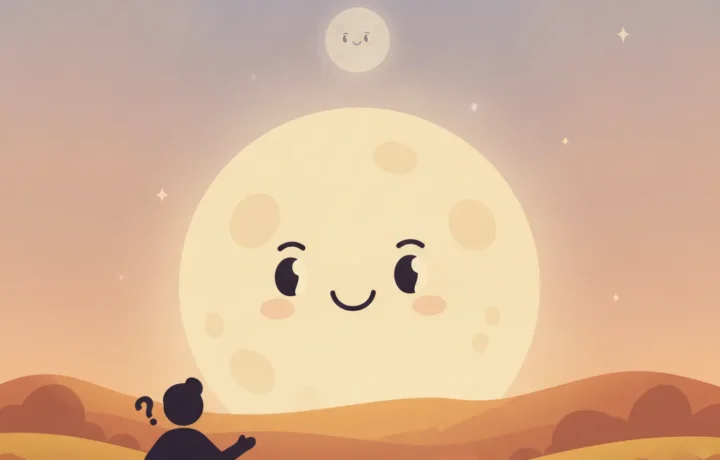
When we observe the Moon on the horizon, it often seems much larger than when it is high above our heads. However, the apparent size of the Moon does not actually change along this path, and the whole thing is a perceptual illusion caused by the way our brain interprets the scene. Understanding this phenomenon requires taking a few steps from everyday experiences to what science explains about the subject.
The first impression observed with the naked eye
Anyone who has admired the Moon rising or setting has probably been surprised by its apparent size. The Moon looks gigantic compared with the same Moon seen hours later, when it is much higher in the sky. This difference is so striking that it often becomes a topic of conversation and photos.
However, if you cover one eye and sight the Moon with your thumb held out, you will see that it covers practically the same space, whether it is on the horizon or overhead. This is a sign that the size does not really change. But even knowing this, the feeling of a bigger Moon persists.
The Moon-on-the-horizon phenomenon does not depend on any device or telescope. Everyone who gets the chance to see a full Moon near the horizon notices this surprising effect, whether in urban areas or in open places.
How our brain interprets the scene
The most accepted explanation connects the illusion to the way our brain judges sizes and distances in wide scenes. When the Moon is on the horizon, there are visual references such as trees, buildings or mountains along the same line of sight. Seeing it alongside these elements, the brain concludes that the Moon is farther away.
For our brain, if something far away appears as large as a nearby object, it tends to consider the distant object larger than it really is. This makes the Moon, being on the horizon and "close" to familiar objects, look much bigger than when it is alone and high in the sky, with no reference at all.
This kind of visual interpretation happens all the time. That is why balls can seem to differ in size depending on how close they are to other objects, even if we measure them and they are identical.
The role of comparisons with nearby objects
One of the main situations that reinforce the Moon-on-the-horizon illusion is when it appears near familiar elements, such as buildings, towers and treetops. When we see both together, we can swear the Moon is larger than normal.
- Casas e prédios: Servem de referência para o cérebro comparar tamanhos.
- Árvores: Reforçam a sensação de proximidade e contraste de escala.
- Montanhas: Dão uma ideia de distância, ampliando ainda mais a ilusão.
- Paisagens abertas: Menos elementos para comparar, porém ainda possível perceber a ilusão.
- Pôr do sol ou amanhecer: A coloração também pode intensificar a impressão de tamanho.
These comparisons are automatic. Just pay attention and notice that, as the Moon rises, the references disappear and the illusion diminishes.
Why the Moon's real size does not change
Despite the impression of change, the Moon stays practically at the same distance from us during the same period of the night. The size seen from our planet, called the "angular size", really only varies over the months, due to the Moon's orbit, not from one hour to the next.
If you photograph the Moon on the horizon and later, high up, with the same camera and the same settings, the Moon's size in the photos will be practically the same. This is a simple way to show that the illusion results from how our vision works, not from a real change.
The atmosphere also plays no role in increasing the apparent size: it may slightly distort the color and outline, but it does not enlarge the image. Thus, it all comes down to what happens in our eyes and brain.
Other theories considered for the illusion
The main explanation is the comparison with objects on the horizon, but other ideas have been suggested for the illusion. One is that the atmosphere would act as a lens, enlarging the Moon, but experiments showed that this is not the case.
Optical theories about distortion by the lens of the human eye have also been proposed, but they cannot explain the full complexity of the phenomenon. Another hypothesis is that the visual proximity to the ground creates a different scale expectation, but this effect does not hold up on its own.
Despite the different lines of explanation, all converge on the same point: the illusion is the result of the way our brain processes the scene, not of an actual change in the Moon's size.
What is still not completely known
Despite many studies, the details of why the illusion is so strong still lack full consensus. Some specialists debate whether it comes more from the processing of visual information or from memories and cultural associations.
It is also not fully clarified why some people perceive the illusion more strongly than others: there may be differences in attention, expectation or prior experience with observing the sky. This is a field where hypotheses still circulate.
Scientists continue to study how combinations of environmental, biological and psychological factors influence the perception of the Moon on the horizon and in other similar situations.
Frequently asked questions
Is the Moon closer when it is on the horizon?
No, the distance between the Moon and the Earth practically does not change over a few hours of a night. The impression of closeness is a visual effect caused by terrestrial references and by the way our brain interprets the horizon scene.
Does the atmosphere increase the size of the Moon?
The atmosphere may slightly distort the Moon's outline, making it look flattened or reddish, but it does not increase its apparent size. The phenomenon of the bigger Moon on the horizon is a perceptual matter, not an atmospheric one.
Why is the illusion easier to notice on full Moon nights?
Because the full Moon is much brighter and easier to observe, it draws more attention when it is close to the horizon. This highlights the effect of comparing it with nearby landscapes and objects, making the perceptual illusion more evident.
Does this phenomenon also occur with other planets or stars?
To a lesser degree, some people report similar impressions with very bright planets near the horizon, but since they are points of light, the effect does not draw as much attention as it does with the Moon, which has a visible apparent diameter.
A fascinating illusion to observe
The feeling that the Moon looks bigger on the horizon is an invitation to watch the sky with extra attention. Realizing that it is a trick of our brain lets us experience the nature of the illusion many times, in different contexts and landscapes.
Observing the Moon at different times, comparing it with photos and sharing the experience are ways to enrich this learning about how our senses work. The phenomenon shows that even something as familiar as the Moon can surprise us.