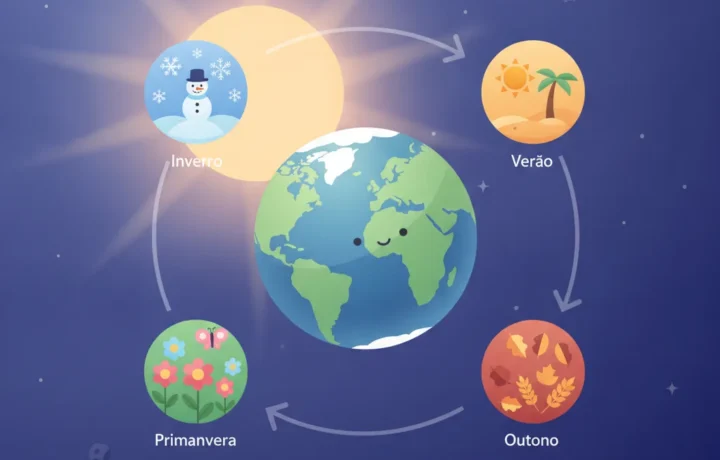
The seasons of the year exist because of the tilt of the Earth's axis relative to the Sun, and not because of the distance between them. Although many people think heat and cold change because we get farther from or closer to the Sun, what really makes the seasons happen is the way sunlight hits different parts of the planet throughout the year.
The role of the Earth's tilt
The Earth's axis is tilted relative to its orbital plane by about 23.5 degrees. This means different regions of the planet receive different amounts of sunlight throughout the year. This phenomenon is responsible for causing climate changes during the seasons.
When one hemisphere is tilted toward the Sun, it receives more light and heat, marking summer in that region. When it is tilted away, it receives less light, characterizing winter. The intermediate periods correspond to spring and autumn.
Without this tilt, temperature variations throughout the year would be much smaller, and we would practically not have seasons as we know them today. The Sun would illuminate the planet more evenly at different times of the year.
What happens during the year
As the Earth orbits the Sun, the tilt of its axis results in changes to the angles and duration of the sunlight received. This causes the seasons to alternate in the northern and southern hemispheres. When it is summer in Brazil, it is winter in countries above the Equator.
At the summer solstice, one of the hemispheres is tilted directly toward the Sun. At the winter solstice, the opposite occurs. The equinoxes mark the moments when sunlight strikes both hemispheres equally, characterizing spring and autumn.
These events help explain why days are longer or shorter depending on the time of year. In summer we have longer days and shorter nights; in winter it is the opposite.
Situations that show the seasons of the year
Changes in the seasons are clear in everyday life in many ways. Trees lose their leaves in autumn in many regions, flowers appear in spring, and summer heat attracts outdoor activities. These phenomena are observed around the world, although they vary according to local climate.
In places farther from the Equator, the seasons are more pronounced, with large differences in temperature and day length. Near the Equator, the climate is more constant all year round, with little variation between seasons.
- In autumn, leaves change color and fall from many trees.
- In spring, flowers bloom and nature comes to life.
- In summer, the days are longer and suitable for beaches and outings.
- In winter, the cold intensifies and the days become shorter.
Why isn't the distance from the Sun what causes the seasons?
Many people think the Earth moves away from the Sun in winter and closer in summer, but this is not what causes the seasons. The Earth's orbit around the Sun is nearly circular, varying little in distance throughout the year.
If distance were the main factor, the seasons would be the same in both hemispheres, which does not happen. When it is summer in the southern hemisphere, it is winter in the northern hemisphere, and this can only be explained by the tilt of the Earth's axis.
The effect of distance on temperature is small compared to the change in the angle of incidence of the sun's rays. The amount of energy received per region is what really makes the difference.
What is not yet fully known about the seasons
Scientists understand well how the seasons happen, but there are still details under study about how changes in the Earth's axis over thousands of years affect the climate. Small variations can alter long-term patterns.
The relationship between the seasons and life in the oceans, for example, is still the subject of much research. How temperature and light variations impact the cycle of marine animals is an question under investigation.
In addition, impacts of modern climate change on the seasons, such as changes in planting and harvest periods, continue to be analyzed, since traditional patterns may be changing in some regions.
Frequently asked questions
Can the Earth's tilt change?
Yes, the tilt of the Earth's axis can vary very slowly over thousands of years. These changes are called Milankovitch cycles and affect the global climate in the long term, possibly contributing to ice ages and warming periods.
Do seasons of the year exist on other planets?
Yes, several planets in the Solar System have seasons, but they can be very different from ours. Everything depends on the tilt of the planet's axis and its orbit around the Sun. Some, like Mars, have seasons that last longer than on Earth.
Why are the seasons more pronounced in some places?
Seasons are more evident in regions farther from the Equator because the angle of the sun's rays changes considerably throughout the year. Near the Equator, sunlight almost always strikes at the same angle, making the climate little variable.
How do seasons affect animals?
Many animals synchronize their behaviors with the seasons. For example, some species migrate or hibernate in winter, while others breed in spring. Changes in light and temperature directly influence these vital cycles.
The cycle of the seasons forming the planet's balance
The seasons of the year are a direct result of the tilt of the Earth's axis, providing diversity of landscapes, temperatures, and adaptations of plants and animals. This cycle is essential for ecological balance and for the different ways of life around the world.
Understanding that it is not the Earth's proximity to the Sun, but the axial tilt, that causes the seasons helps demystify common ideas and appreciate the way our planet relates to the Sun in space.