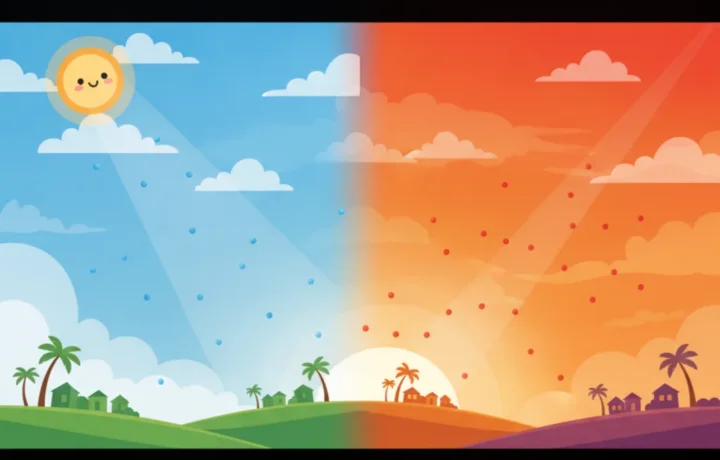
The sky is blue during the day and takes on orange tones at sunset due to the way sunlight interacts with the gases in the atmosphere. This change happens because sunlight, as it passes through air of different thicknesses, undergoes a process called scattering, which affects the colors we see in the sky at each moment of the day.
How sunlight turns into the blue of the sky
Sunlight, although it seems white, is made up of several colors that together create this effect. When light hits the atmosphere, tiny particles and molecules scatter this light in many directions. Colors with shorter wavelengths, such as blue and violet, are scattered more easily than colors with longer waves, such as red.
Although violet is scattered even more than blue, our eyes perceive this color less, which is why blue dominates. During the day, with the Sun high, the path light travels through the atmosphere is shorter, making this bluish hue dominate in all directions.
So when you look away from the Sun, what you see is this blue scattered throughout the atmosphere. This phenomenon, called Rayleigh scattering, occurs constantly whenever sunlight falls on the blue sky.
Why the sky changes color at dusk
At the end of the afternoon and at sunrise, the situation changes because the Sun is lower on the horizon. At these times, light has to pass through a thicker layer of the atmosphere to reach our eyes. This longer path causes almost all of the blue and violet light to be scattered away from our line of sight.
What remains is mainly light with longer wavelengths, especially orange and red. That is why the sky near the Sun appears reddish and orange at these moments. This effect is more intense when there are more particles in the air, such as dust or pollution.
In addition, the colors can vary greatly depending on the day's weather. Humid skies, with thin clouds or a lot of dust, enhance these warm tones at sunset, creating impressive landscapes.
Everyday situations where the phenomenon is evident
In everyday life, this phenomenon can be observed many times, showing how the sky changes tone over time. A clear example is when we see the horizon very reddish after a dry day, full of dust in the air. The orange and even pinkish tones become more evident.
Another interesting moment is right after a storm, when the sky usually shows a very intense blue. The rain "cleans" the air, reducing the amount of particles and favoring a purer blue sky.
- During airplane trips, it is common to notice different tones in the sky depending on the altitude.
- In urban areas with pollution, the sunset tends to be redder than in open fields.
- In high-altitude places, the sky is even bluer due to the thinner and cleaner air.
- After fires, the sunset can take on even more intense tones because of the ashes suspended in the air.
Explaining the step-by-step of the phenomenon
It all begins with sunlight reaching the atmosphere. The particles and molecules present there come into contact with this light, scattering the components of shorter wavelength such as blue. This process happens in all directions, which makes the sky look blue to someone on the ground.
When light crosses a longer path at the end of the day, the blue is almost entirely deflected, leaving only the colors with longer wavelengths. When looking at the horizon at these hours, we see the sky orange or reddish.
Thus, the color of the sky depends both on the position of the Sun and on what is present in the atmosphere, such as dust or humidity. All of this together makes this dance of colors that so draws attention in everyday life.
What makes the sky's tone vary even more
Besides the position of the Sun and natural particles, climatic factors such as smoke from burnings, pollution, or even thin clouds can greatly alter the intensity of the colors seen. With more particles, the sunset tends to be more intense and colorful.
On very hot days, when air rises quickly, dust and water droplets stay suspended, making the sky less blue and more whitish. The same goes for days of mist or fog, when humidity makes it harder to observe the intense blue.
On the other hand, even at great altitudes, such as on mountain peaks, the sky can look a deep dark blue. This happens because of the lower concentration of particles and the "thinner" atmosphere.
Ways science still researches the blue sky
The basic explanation of the blue sky and the colors of sunset is very well established, but details are still a subject of curiosity. For example, scientists study how specific particles, such as aerosols from volcanoes or pollution, change the tone of the sky in each region.
Another area that still gives rise to hypotheses is the effect of solar storms on the color of the sky at high latitudes. When there are auroras, the atmosphere takes on greenish tones that defy the rule of sunset colors.
Efforts are also made to understand all the subtleties of how human vision perceives these colors, since aspects such as eye health and even cultural habits can affect the perception of blue and orange.
Frequently asked questions
Why isn't the sky completely violet, since that color is more scattered?
The sky isn't violet because the human eye is less sensitive to violet than to blue, so we perceive blue more intensely. In addition, part of the violet light is absorbed by ozone in the atmosphere, reducing its presence.
Is it possible to see an intense blue sky anywhere on the planet?
Not always. In polluted regions, the sky can look more opaque or grayish. In places with clean mountain air or islands far from cities, the blue tends to be much more vibrant due to the purity of the air.
Can the sunset be colors other than orange and red?
Yes, although orange and red are the most common, there can also be shades of pink, purple and even gold, depending on the type and amount of particles in the air and the humidity present in the atmosphere.
What factors can make the blue sky look whitish during the day?
The blue sky can look whitish due to high humidity in the air, dust, pollution or smoke. These particles increase the scattering of all colors, resulting in a less blue and paler tone.
From Marveling at the Gaze to Understanding the Blue of the Sky
Learning why the sky is blue during the day and orange at dusk reveals how our planet combines physics, atmosphere and biology in an impressive way. Each color in the sky tells a story about the path light travels and the conditions of the air.
Observing the sky every day is proof of how small details can change an entire landscape. The next time the sky is bright blue or intense orange, remember the role that light, the atmosphere and even our own eyes play in this daily spectacle.