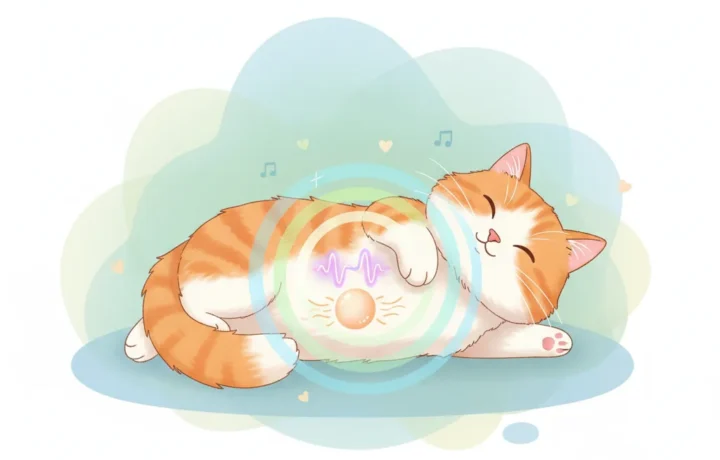
Cats purr mainly when they are relaxed, but also in other situations. Purring is a characteristic sound, recognized by anyone who lives with cats. It is not only an expression of pleasure, since cats can purr in moments of pain or anxiety. The reason for purring and its mechanism still intrigue researchers, but today much of what happens in the cat's body while it produces this sound is already known.
What cat purring is
Purring is a low, continuous, vibrating sound produced by many felines, especially the domestic cat. It is usually heard when the cat is in comfortable situations, such as while being petted, sleeping or eating. Variations of this sound exist depending on the species, but that of the house cat is one of the most studied.
The vibration is easy to notice when you touch a purring cat. The noise is usually rhythmic and can last for a long time. Not all cats purr in the same way; some are more discreet, while others make the sound heard throughout the entire environment.
This behavior is also seen in kittens. They begin to purr while still nursing, which may be a form of communication with the mother and littermates, indicating well-being and close presence.
How purring is produced in the cat's body
Purring begins with the cat's brain sending signals to the muscles of the larynx. These muscles vibrate rapidly, several times per second, while the cat inhales and exhales. It is this vibration that creates the sound and the slight tremors felt when touching the animal's neck.
Air passing through the vibrating vocal cords reinforces the sound. Cats can modulate purring both while inhaling and while exhaling, which makes the sound constant and almost without pause. This mechanism is unique and is not present in all wild felines.
Although the basic stages of purring production are known, details such as the exact frequency of the impulses and the participation of different muscles are still being studied. Therefore, the complete mechanism may vary somewhat from one cat to another.
In which situations cats usually purr
Normally associated with a context of tranquility, purring can be observed in many situations. It appears when the cat is petted, feels safe on a lap or is relaxed in its usual environment. But purring also occurs in scenarios of pain or discomfort, such as during visits to the veterinarian.
Besides purring alongside its mother, kittens use the sound to indicate that they are nursing well. In adult cats, purring can serve to show satisfaction after enjoyed meals or even during a sunny nap. These moments show that the sound is multifunctional.
- When receiving affection from people or other cats.
- When they are eating or nursing.
- During moments of stress or insecurity.
- While recovering from injuries or illnesses.
- When approaching other animals or humans.
What is believed to be the function of purring
The exact function of purring is not yet consensual, but there are accepted hypotheses. One is that purring serves as a form of communication of calm and satisfaction, both between cats and toward humans or other nearby animals. Another hypothesis suggests that the vibration may play a role in the animal's physical recovery.
Researchers have raised the possibility that purring helps in the healing of bones and tissues, due to the frequency of the vibrations. Although this theory is interesting, there is still no solid confirmation of it. Therefore, it is treated as a possibility rather than a certainty.
Other scholars suggest that purring is a request for attention or help, especially when the animal is uncomfortable. Purring in negative situations would serve to draw the attention of owners or other cats.
Practical examples of purring in everyday life
In the daily life of those who live with cats, it is common to observe purring during rest, right after the cat finds a cozy spot. Many cats purr during petting sessions, naps on a lap and even just in the presence of their guardian.
On the other hand, there are reports of cats that purr while showing signs of fear, such as during strong storms or trips to the veterinarian. In these situations, purring may have meanings different from pure relaxation.
There are also examples of cats that purr after being fed, as if thanking or expressing contentment. In homes with more than one cat, purring may occur during social interaction, indicating harmony or a request for closeness.
What is still unknown about purring
Despite advances, parts of purring remain an enigma. For example, how do different emotional states influence the quality and frequency of this sound? Why do some cats almost never purr, even when they seem happy? These questions remain open.
There are still no clear answers about how purring develops over the cat's life and whether there are marked genetic differences between individuals or breeds. The details of the neuromuscular mechanism are still a subject of debate and research.
Another interesting question is understanding how cats keep purring for so long without tiring, since there is no clear pause in the emission of the sound. These points are still being gradually uncovered by science.
Frequently asked questions
Do big cats, such as lions, also purr like domestic ones?
Lions and other large felines make sounds similar to purring, but with important differences. They cannot purr continuously like the domestic cat and, in most cases, only produce sounds close to purring while exhaling. The purring mechanism is more characteristic of domestic cats and some of their close relatives.
Do kittens learn to purr or are they born knowing how?
Purring appears in the first days of a kitten's life and seems to be an instinctive behavior, not learned through observation. Even before their eyes open, kittens are already able to make this sound, using it mainly during nursing to communicate with their mother and siblings.
Do some cats never purr? Does that mean something is wrong?
Some cats really purr very little or in an almost imperceptible way, without this indicating health problems. The absence of audible purring may simply be an individual trait, related to the animal's anatomy or even personality. What matters is observing whether the cat's overall behavior is normal.
Is there a way to encourage a cat to purr more?
There is no foolproof recipe for stimulating purring, as it depends on the cat's own willingness and well-being. Offering comfort, affection and a calm environment may encourage the behavior to appear, but each individual responds in its own way, and forcing the situation is not advised.
Purring: a fascinating mystery of cats
The phenomenon of purring shows how cats are complex and intriguing animals. The sound, so common in domestic life, reveals many functions and mysteries that are still being investigated. It goes far beyond a simple expression of happiness or relaxation.
Understanding purring means approaching the feline world while respecting its particularities. What matters, for those who appreciate cats, is knowing how to recognize the varied situations in which this sound appears, valuing it as a special part of the communication of these beloved animals.