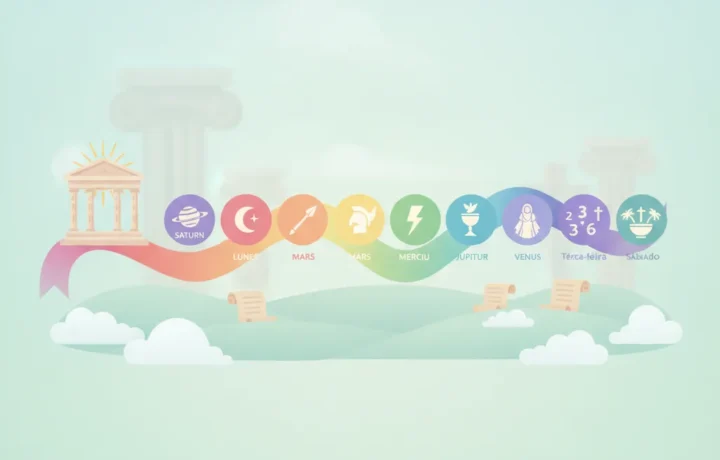
The names of the weekdays in Portuguese are different from those of other languages, as they use numbers, such as "segunda-feira" (Monday) and "terça-feira" (Tuesday), instead of celestial bodies or gods. This custom arose for religious reasons and ended up creating a unique tradition among modern languages. Thus, while other languages keep ancient references to celestial bodies, Portuguese innovated in this way of naming the days.
Where the numerical names of the days came from
In Portuguese, almost all the days of the week are named with numbers followed by "-feira", such as "segunda-feira" and "terça-feira". This is due to changes made during the Middle Ages, when the Catholic Church suggested avoiding names linked to pagan gods. Thus, neutral and numerical names were chosen.
Domingo, which means "day of the Lord", and sábado, from the Hebrew "Shabbat", are exceptions, as they keep old religious links. "Feira" originally meant a day of rest and celebration. The names were eventually adopted officially in regions where Portuguese was spoken, such as Brazil and Portugal.
Curiously, the numerical pattern and "feira" set Portuguese apart from Spanish, French and Italian, whose names for the days still refer to planets or Roman gods. This choice had a cultural impact and remains present to this day.
Historical records and traditions over time
Names such as "segunda-feira" began to appear in the official and liturgical documents of the Catholic Church in Portugal. Before that, Latin used names associated with planets, similar to the pattern seen in other Latin languages. The new format was gradually adopted, influencing the everyday life of Portuguese speakers.
These changes were marked by debates among religious figures and by the effort to harmonize the Christian calendar with the Church's values. The records show that the numerical tradition became established over centuries and eventually became the standard as Portuguese evolved as its own language.
Even today, the choice of names symbolizes a historical connection with Christianity and the cultural distinction between the peoples who speak Portuguese and their neighbours. Official books and religious texts still reflect this custom.
The difference from other European languages
In Spanish, French, Italian and English, the days of the week honour planets or ancient gods. For example, "Monday" in English comes from the Moon and "Martes" in Spanish is Mars. These traditions persisted even after the adoption of Christianity in these countries, preserving the memory of ancient mythologies.
In Portuguese, however, following the ecclesiastical tradition, the days were renamed to eliminate associations with paganism. This is so striking that Portugal and Portuguese-speaking countries are exceptions among the Romance languages regarding the naming of the week.
The change did not extend to other neighbouring languages, showing how each society dealt differently with the inheritance of ancient religions and with the Christian calendar.
The influence of the Roman and Christian calendar
The ancient Roman calendar named the days based on celestial bodies and gods, inheriting practices from the Greeks and Persians. With the spread of Christianity, the desire arose to adapt these customs to avoid pagan references, but this change was only widespread among Portuguese speakers.
During the Middle Ages, the Christian calendar sought to highlight Holy Week, organizing the days in relation to Easter. The idea of "feria" arose, which was a pause from worldly activities. Thus, the days "feria secunda" and "feria tertia" soon became segunda-feira, terça-feira, and so on.
- Domingo – day of the Lord
- Segunda-feira – second working day after Sunday
- Terça-feira – third working day
- Quarta-feira, quinta-feira, sexta-feira – numerical sequence
- Sábado – from the Hebrew "Shabbat", sacred rest
What is still doubtful or debated on the subject
Despite many historical records, some details of the process by which the names of the weekdays were adopted are still a matter of debate. For example, there is no complete consensus on the exact moment when the numerical names became the standard among the entire population.
Another point under discussion concerns the extent of this tradition in areas where Portuguese is spoken outside Europe. Although the rule remains, there may be local variations in small communities or in informal situations, where old names persist in collective memory.
The subject also arouses curiosity about how cultural and religious factors influence our perception of time and the organization of social life. Researchers are still exploring how this shaped the linguistic identity of Portuguese-speaking peoples.
How the tradition of the weekdays remains alive
In Brazil, Portugal and other Portuguese-speaking countries, the names of the days remain in formal and everyday use. Despite globalization, calendars, schools and the media keep the terms "segunda-feira" through "sexta-feira", reinforcing the tradition.
Even knowing the difference from other languages, people rarely question the reason behind these names. The convention is already part of life and customs, causing no surprise in the daily lives of speakers.
In literature and official records, the standard adopted in the Middle Ages is maintained. It is one of the most lasting cultural and linguistic hallmarks of Portuguese, preserving a history that began many centuries ago.
Frequently asked questions
Why was the word "feira" used in the names of the days?
In the historical context, "feira" was used to indicate days of rest or religious celebration, especially in Church calendars. The term comes from the Latin "feria", which meant a time of pause, marked by prayer and abstention from ordinary work. That is why it came to form the names of the working days of the Portuguese week.
Do all Portuguese-speaking countries follow these names?
Yes, the “segunda-feira” through “sexta-feira” pattern is officially followed in Brazil, Portugal, and other regions where Portuguese is spoken. In everyday life there may be popular variations, but in formal texts, calendars, and schools, the numbered names have predominated since their adoption by the Catholic Church.
When did the custom of numbering the days of the week arise?
The custom became established during the Middle Ages, especially among Christian communities. Numbering the days was an alternative to names of planets or gods, in line with the aim of separating Christian practices from pagan culture. The usage spread gradually and was consolidated over time.
Does the Portuguese word for Saturday, “sábado,” have a different origin from the other days?
Yes, “sábado” derives from the Hebrew “Shabbat,” which represents the traditional Jewish day of religious rest. This name was kept due to strong biblical influence and because it already had a religious meaning even before the numbering of the other days of the week was adopted in Portuguese.
The linguistic legacy of the names of the days of the week
The way we name the days of the week in Portuguese reveals a great deal about our history and the way different peoples reshaped ancient traditions to fit the Christian calendar. This system is unique among the Romance languages and remains present today in the daily life and culture of Brazil and other Portuguese-speaking countries.
The tradition of the numbered names with “-feira” shows how the Portuguese language inherited religious customs and ideals, recording in its vocabulary the path our history has taken to the present.