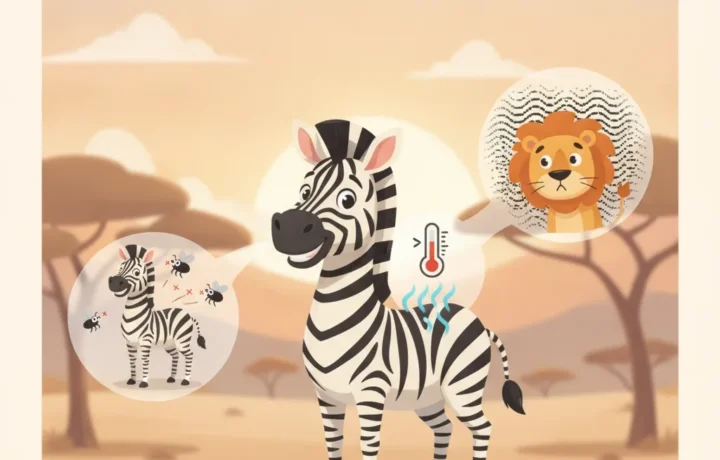
Zebra stripes have long intrigued scientists and curious people alike. The most widely accepted explanation today is that the stripes help keep insects away, mainly flies. However, other hypotheses have been raised over time, such as camouflage, thermal regulation and social identification. Below, learn what has already been discovered, what is still under discussion, and which situations have inspired research into zebra stripes.
Observing zebras in the African savanna
On the savanna, it is not hard to notice that zebras stand out because of their black-and-white striped pattern, something unique among large mammals. The visual difference is striking, even from a distance. The contrast of the stripes draws attention, making them easily recognizable to almost any observer.
Despite their eye-catching appearance to humans, zebras live alongside predators such as lions, hyenas and leopards, which has always raised discussion about the possible value of the stripes for their survival. It is also observed that many other equine species, such as horses and donkeys, do not have this pattern.
Zebra behaviors in everyday life, such as walking in groups or crossing open areas, have motivated different lines of research into the evolutionary meaning of the stripes. These everyday observations have always fueled the scientific debate.
The main hypotheses about zebra stripes
Several explanations have been proposed for zebra stripes. Among them are camouflage against predators, defense against biting insects, regulation of body temperature, and identification among members of the group.
- Camouflage: The stripes could confuse predators by making it harder to count the zebras in the group.
- Defense against insects: The stripes bother some types of flies, repelling them from zebras.
- Thermal control: Variations in color would help air circulation and cooling of the body.
- Social recognition: Unique patterns would make it easier to identify individual zebras.
Each hypothesis has been tested over the years, but the relationship with insects is the most strongly supported.
How defense against insects gained support
The hypothesis that the stripes drive away flies and other insects did not come out of nowhere. Researchers observed that zebras are bitten less than other large savanna animals. The striped pattern seems to confuse insects' vision or make it difficult for them to land.
Experiments comparing striped, black and white skins indicate that insects land less often on surfaces that imitate zebra stripes. This effect held both with live zebras and with striped objects left in the field, reinforcing the protective role of the stripes.
The protective effect is mainly related to flies that transmit diseases, a serious problem for the health of wild animals. For this reason, the insect defense theory is currently the most accepted among specialists.
Views on camouflage and recognition
Camouflage has always seemed contradictory, since the stripes attract attention from a distance. Some argue that, in the shade of trees or within groups, zebras become harder for predators to tell apart.
Social identification is possible because each zebra has a unique stripe pattern. This singularity could help mothers recognize their foals. However, this function seems secondary compared with the advantages against insects.
Thermal control, for its part, attracted interest because of the extreme temperatures of the savanna, but tests showed no significant difference in cooling between zebras and other equines without stripes.
Examples of situations where the stripes make a difference
In areas where tsetse flies and other disease-carrying insects are common, zebras seem to suffer fewer bites than other furry animals with solid colors. Horses painted black and white have also been used to test the effect in practice.
The benefit of the stripes is most noticeable during the day, when insects are active and the zebra is exposed to them. In groups, the stripe pattern may also create a confusing visual effect, although this does not stop experienced predators from attacking.
It can be said that, in the wild, the stripes protect more against small enemies than against large predators. This even influences the overall health of zebras in varied habitats.
What is still not known about zebra stripes
There are still questions about why the stripes work so well to keep away certain insects but not all of them. The details of how insect vision reacts to the patterns have not been fully clarified.
It is not certain why other species similar to zebras have not developed similar patterns, even while living in environments with many insects. There are also debates about the role of the stripes in relation to extreme heat and communication within the group.
Research on zebra stripes continues because other functions, beyond protection against insects, may exist. Possible combined benefits are still being studied by specialists.
Frequently asked questions
Are zebra stripes the same in every individual?
No, each zebra has a unique stripe pattern. Just like fingerprints in humans, the lines and shapes vary from one zebra to another. This can help with recognition between individuals, especially between mothers and foals, but it is not the main reason the stripes exist.
Do zebra stripes change over the animal's life?
The stripes appear right at birth and remain practically the same throughout the zebra's life. Very small changes can occur from scars or natural wear of the coat, but the basic design of the animal does not change over time.
Do domesticated zebras lose their stripes?
Domesticated zebras keep their stripes, since they are part of the species' genetics. Even in environments different from the savanna, the striped pattern is a fixed trait, not depending on external factors to appear.
Do other animals have stripes similar to those of zebras?
Some other animals, such as certain types of fish, insects and mammals, have stripes on their bodies. However, among large equids, zebras are unique in having this striking striped pattern across their entire body.
The role of zebra stripes in nature
Zebra stripes are an excellent example of how striking features in nature can have surprising functions. Science shows that the main advantage of the stripes is protection against insects, rather than against large predators, as was previously thought.
Although other hypotheses should continue to be studied, it is now recognized that the stripes make a difference to the health and survival of zebras. This natural curiosity continues to inspire research and fascinate those who observe these animals on the African savanna.